Brisbane's National Park Playground
Brisbane is uniquely blessed with world-class national parks within easy driving distance. From ancient Gondwana rainforests in the Gold Coast Hinterland to volcanic glass peaks on the Sunshine Coast and pristine island ecosystems offshore, there's no shortage of natural wonder for campervan travellers.
These parks offer everything from half-day walks to multi-day camping adventures, making them perfect additions to your east coast road trip or standalone weekend escapes from the city. With a campervan, you can explore several parks in a single trip, sleeping right at the doorstep of some of Australia's most spectacular wilderness.
What makes Brisbane's national park scene special is the sheer diversity packed into a small radius. Within 90 minutes of the CBD, you can walk through 100-million-year-old rainforest, climb volcanic peaks, kayak through mangrove-lined waterways, or snorkel a shipwreck-turned-coral-reef. Here's our guide to the best national parks near Brisbane for campervan adventures.
Lamington National Park
Distance: 110 km south | Drive Time: 1.5 hours
Lamington National Park is a World Heritage-listed Gondwana Rainforest — part of an ancient ecosystem that dates back over 100 million years. The park protects 20,600 hectares of subtropical rainforest along the McPherson Range, which forms the border between Queensland and New South Wales. It's one of the most biologically diverse places in Australia, home to over 900 plant species and 190 bird species.
The park has two main sections: Green Mountains (O'Reilly's) and Binna Burra. Green Mountains is the most accessible and popular, featuring the famous Tree Top Canopy Walk — a 180-metre elevated walkway through the rainforest canopy, 15 metres above the ground. The walkway gives you a bird's-eye view of the forest and its inhabitants, including colourful birds, butterflies, and the occasional python draped across a branch.
Best Walks at Lamington
- Box Forest Circuit — 17 km return, 5–6 hours. A challenging but rewarding loop passing through some of the park's finest rainforest and several stunning waterfalls, including the beautiful Box Log Falls.
- Python Rock Track — 3.4 km return, 1.5 hours. An easy walk to a rocky outcrop with breathtaking views into the deep Coomera Valley.
- Moonlight Crag — 5.4 km return, 2.5 hours. Passes through Antarctic beech forest (relics from when Australia was part of Gondwana) to a cliff-edge viewpoint.
- Albert River Circuit — 14 km, 5 hours. A varied walk that descends into the Albert River valley through open eucalypt forest before looping back through rainforest. Less busy than the more popular circuits.
Birdlife: Lamington is one of Australia's premier birdwatching destinations. Look for regent bowerbirds (striking black and gold), paradise riflebirds (related to birds of paradise), crimson rosellas, satin bowerbirds, and the elusive Albert's lyrebird. O'Reilly's has wild king parrot feeding every morning — the birds will land on your hand.
Camping: Green Mountains campground offers basic bush camping sites with water and pit toilets (book via QPWS, from $7.75/person/night). O'Reilly's Rainforest Retreat has a campground with powered sites and hot showers if you prefer more facilities. Binna Burra's campground was damaged in bushfires in 2019 but has since reopened with new facilities.
Springbrook National Park
Distance: 100 km south | Drive Time: 1.5 hours
Another World Heritage Gondwana Rainforest, Springbrook is perched on a 900-metre plateau above the Gold Coast Hinterland. It's famous for the Best of All Lookout — and it genuinely deserves that name. The panoramic view stretches from Mount Warning (the ancient caldera rim of the Tweed Volcano) across a sea of green forest to the coast, and on clear days it's one of the most spectacular vistas in Southeast Queensland.
The park is divided into four sections, each with distinct character:
Springbrook Plateau
The main section with most of the walks and the Best of All Lookout. The Purling Brook Falls circuit (4 km return, 1.5 hours) is the standout walk, passing a dramatic 106-metre waterfall cascading into a fern-lined amphitheatre, then looping through the valley below with deep rock pools perfect for a cool dip on hot days. The Warrie Circuit (17 km, 5–6 hours) is a longer option that links several waterfalls and passes through pristine sub-tropical rainforest.
Natural Bridge
This section is home to a glow-worm colony inside a cave behind a waterfall — one of only a few places in the world where you can see this phenomenon. Visit after dark (the car park is open until 8pm) for the full bioluminescent experience. Hundreds of tiny glow-worms light up the cave ceiling like a blue-green starfield. It's genuinely magical and worth the short 1 km walk in the dark.
Mount Cougal
The least-visited section, with a beautiful series of cascading waterfalls and rock pools along Currumbin Creek. It's popular for swimming on hot days and rarely crowded.
Camping: Springbrook has limited camping — the Settlement Campground on the plateau offers basic sites. For campervan-friendly options, Springbrook Mountain Manor and several private campgrounds on the plateau road offer powered sites.
Glass House Mountains
Distance: 70 km north | Drive Time: 1 hour
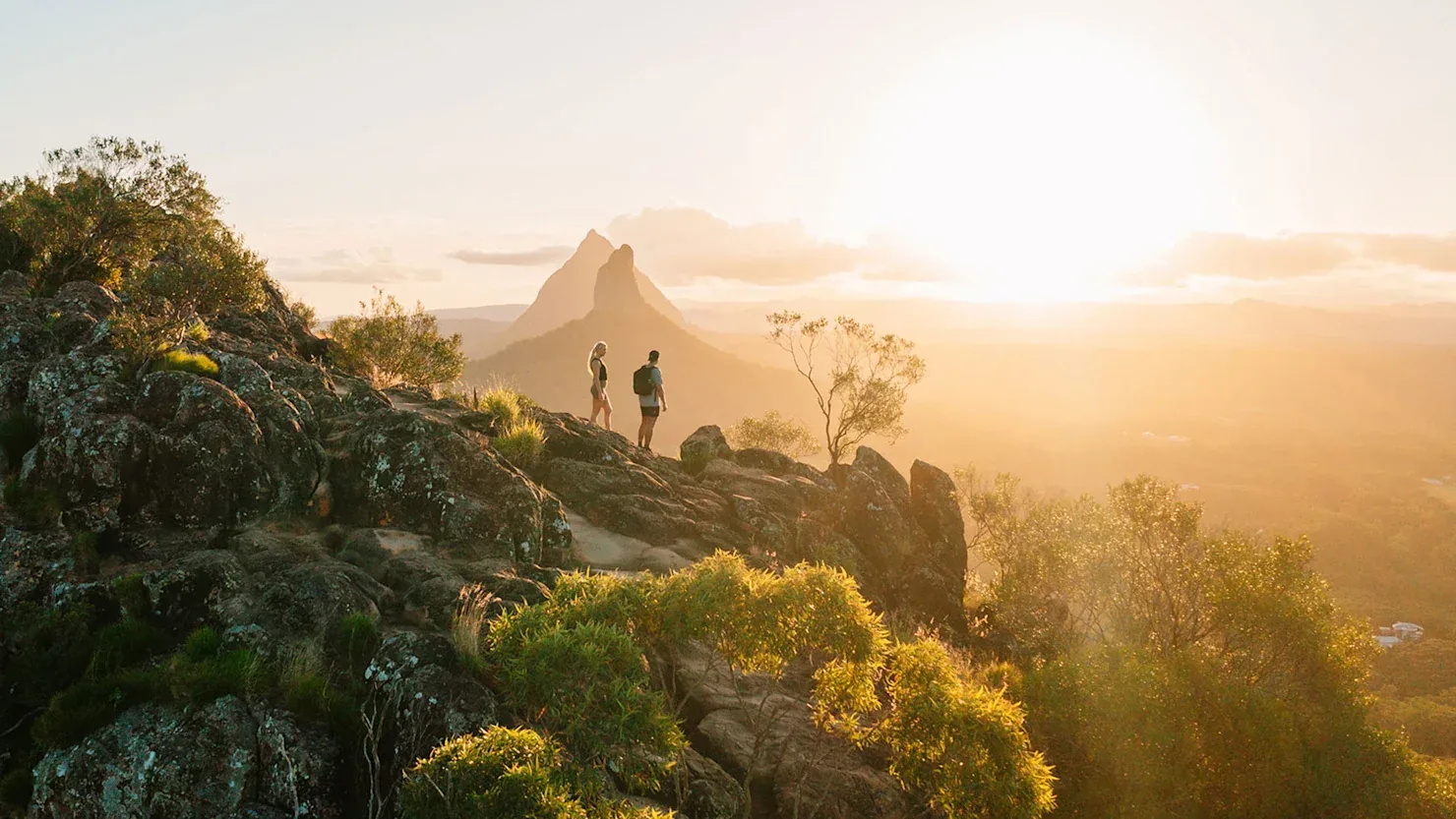
The Glass House Mountains are a cluster of 13 volcanic peaks rising dramatically from the coastal plain north of Brisbane. Named by Captain Cook in 1770 (he thought they resembled glass furnaces in his native Yorkshire), these ancient volcanic plugs are 26–27 million years old and are deeply sacred to the Jinibara and Kabi Kabi Aboriginal peoples.
The peaks are the eroded cores of ancient volcanoes — the softer surrounding rock has long since washed away, leaving the hard rhyolite and trachyte plugs standing like monuments above the flat pineapple and macadamia farms below. The visual impact is extraordinary, especially at sunrise when the peaks glow orange above the morning mist.
Best Climbs
- Mount Ngungun — 2.8 km return, 45 minutes. The best climb for most fitness levels, with a well-maintained track to a rocky summit offering 360-degree views across every peak in the group, the Sunshine Coast beaches, and Moreton Bay. Sunrise here is spectacular.
- Mount Tibrogargan — 3.4 km return, 2–3 hours. A challenging rock scramble up exposed trachyte rock to a summit with panoramic views. Requires good fitness and a head for heights — the final section involves scrambling over large boulders. Not recommended in wet weather.
- Wild Horse Mountain Tower — A short walk to a fire tower with excellent views of all the peaks from an elevated vantage point. Good option if you want views without a strenuous climb.
Aboriginal Significance: The Dreaming story tells of Tibrogargan (the father) and Beerwah (the mother) and their children (the surrounding smaller peaks). Mount Beerwah is the tallest peak (556 m) but is closed to climbing out of respect for Aboriginal cultural significance — please respect this closure.
Camping: Glass House Mountains Ecovillage offers campervan-friendly sites with mountain views. The nearby Beerwah and Landsborough area has several holiday parks. The Glass House Mountains Lookout Circuit (a driving circuit connecting several viewpoints) is a great way to see all the peaks without climbing any of them.
Moreton Island National Park
Distance: Ferry from Brisbane | Drive Time: 75-minute ferry
Moreton Island is the world's third-largest sand island, and 95% of it is national park. Just 40 km offshore from Brisbane, it feels like a different world — pristine beaches stretching for kilometres, massive sand dunes, crystal-clear freshwater lakes, and abundant marine life.
Top Experiences on Moreton Island
- Sand Tobogganing — Mount Tempest (280 m) is the highest coastal sand dune in the world. Grab a sandboard and toboggan down the massive dunes at up to 40 km/h — it's an adrenaline rush and endlessly fun.
- Tangalooma Wrecks Snorkelling — 15 ships were deliberately sunk off Tangalooma Point to create a breakwall, and over 50 years they've become a vibrant artificial reef. Snorkel among tropical fish, wobbegong sharks, sea turtles, and colourful corals. Bring your own gear or hire from Tangalooma Resort.
- Wild Dolphin Feeding — Tangalooma Resort offers nightly hand-feeding of wild bottlenose dolphins. It's a unique encounter — the dolphins are completely wild and choose to visit each evening.
- Blue Lagoon — A stunning freshwater perched lake surrounded by white sand and paperbark trees. The water is clean, warm, and perfect for swimming. One of the most beautiful swimming spots near Brisbane.
- Cape Moreton Lighthouse — Queensland's oldest lighthouse (built 1857) on the island's northern tip. From June to November, it's one of the best whale watching spots in Southeast Queensland.
Camping: Several campgrounds are available around the island (book via QPWS). The Tangalooma Beach campground and Blue Lagoon campground are the most popular. Note: you need a 4WD vehicle or 4WD camper to access the island — standard campervans cannot drive on Moreton Island's sand tracks. A vehicle barge operates from the Port of Brisbane.
D'Aguilar National Park (Bonus: Closest to Brisbane)
Distance: 15 km northwest | Drive Time: 30 minutes
Often overlooked by visitors focused on the Gold Coast Hinterland, D'Aguilar National Park is the closest national park to Brisbane's CBD and covers a huge area of eucalypt forest and rainforest along the D'Aguilar Range. It's perfect for a quick half-day escape or a scenic drive.
The Mount Nebo and Mount Glorious road winds along the ridgeline through rainforest with several scenic lookouts over the Somerset and Wivenhoe dam regions. Walk the Morelia Track (3.8 km circuit) through vine-draped rainforest, or try the longer Greene's Falls Track (5.5 km return) to a secluded waterfall and swimming hole in the forest. The Walkabout Creek Discovery Centre at the park entrance has wildlife exhibits, platypus viewing, and is a great introduction to Queensland's native animals.
Tours & Experiences Around Brisbane
Brisbane and its surrounds offer far more than just national parks. From whale watching off Moreton Bay to kayaking through mangroves, there are guided experiences that can take your trip to the next level.
Getting There by Campervan
All of these national parks (except Moreton Island) are accessible by standard 2WD campervan. Here are some practical tips for planning your national park itinerary:
- Mountain roads: Roads to Lamington and Springbrook are winding mountain roads with steep sections. Take it slow, use low gear on descents, and be prepared for narrow sections where you may need to pull over for oncoming traffic.
- Glass House Mountains: Flat, easy access on sealed roads. Great for any campervan size.
- Moreton Island: 4WD only. Consider a 4WD camper hire from Brisbane if you want to include Moreton Island in your trip.
- Combine parks: Lamington and Springbrook can easily be combined in a 2–3 day trip through the Gold Coast Hinterland. Glass House Mountains work well as a stop on the way to the Sunshine Coast and north towards Cairns.
Booking campsites: All Queensland national park camping must be booked through the Queensland Parks and Wildlife Service website. Book well ahead for school holiday periods. Fees are very reasonable — typically $7.75/person/night for basic camping.
Best Time to Visit
Brisbane's national parks are genuinely year-round destinations, thanks to Southeast Queensland's subtropical climate:
- Autumn (March–May): The sweet spot — warm days, cool nights, lower humidity, and fewer crowds. Perfect conditions for hiking and camping.
- Winter (June–August): Cool, dry, and sunny. The best time for strenuous hikes. Whale watching season off Moreton Island (June–November). Night can be cold at altitude in Lamington and Springbrook.
- Spring (September–November): Wildflowers emerge, wildlife is active (breeding season for many species). Generally dry and warm.
- Summer (December–February): Hot and humid with afternoon thunderstorms. Waterfalls are at their most impressive. Swimming holes are a welcome relief. Be prepared for leeches on rainforest walks after rain.
📍 For brand picks and pricing, read our Brisbane campervan hire guide.
Planning your trip?
Compare campervan & motorhome hire prices across Australia: