Why Long-Term Hire Is a Different Game Entirely
Hiring a campervan for a weekend in the Grampians and hiring one for three months across Australia are completely different transactions. The pricing logic is different, the negotiating leverage is different, and the operators who are worth your time are different. If you walk into a long-term booking using the same assumptions you'd bring to a seven-day hire, you'll almost certainly overpay — or end up locked into conditions that don't suit a big trip.
This guide focuses specifically on the best long term campervan rental companies australia travellers should consider for hires of 21 days or more, with a particular focus on who actually discounts monthly rates, which operators include unlimited kilometres, and what you can realistically push back on before you sign anything.
If you want a broader overview of how long-term hire works across different durations, the Long-Term Campervan Hire Australia: 1 to 12 Month Guide is a solid starting point. For a detailed breakdown of what you should expect to pay at different hire lengths, see How Much Does Long-Term Campervan Hire Cost in Australia?
The Operators Worth Knowing for Long-Term Hire
Australia has a well-developed campervan hire industry, but not every operator is set up for long-term bookings. Here's an honest rundown of the main players and how they approach extended hire.
Apollo Campers
Apollo is one of the largest operators in the country, with depots in Sydney, Melbourne, Brisbane, Adelaide, Perth, Darwin, and Cairns. For long-term hire, Apollo is worth considering because they have a structured tiered pricing model — the longer you hire, the lower the daily rate. Monthly hires typically attract meaningful discounts compared to their weekly rates, and they're generally open to negotiation on one-way fees if you're flexible on drop-off location. Unlimited kilometre options are available on most vehicles, though you'll need to select this specifically — it's not always the default. Minimum hire periods vary by vehicle class but are commonly around five to seven days.
Britz
Britz sits in the mid-range bracket and is particularly popular with travellers doing the classic Darwin-to-Adelaide or Perth-to-Sydney routes. Their long-term rates are competitive, and they regularly run early-bird pricing that stacks reasonably well with extended hire discounts. Unlimited kilometres are available but come at an added daily cost on some vehicle categories — worth checking carefully. Britz is owned by the same parent company as Maui and Mighty, which means their depot network and vehicle standards are consistent across brands.
Maui
Maui is the premium tier of the same group. If you're planning a long trip and want a well-appointed motorhome — think proper beds, a real kitchen, and reliable air conditioning for the Queensland coast in January — Maui is worth the extra spend. Daily rates for long-term hire can sit anywhere from $180 to $280 AUD depending on vehicle size and season, which adds up, but the vehicles hold up better over months of continuous use. They're less likely to discount aggressively, but one-way fees and insurance excess reductions are areas where you can sometimes negotiate.
Jucy
Jucy is a budget-friendly operator with a younger demographic in mind. Their compact campervans — the Crib and Chaser models — are practical for solo travellers or couples who don't need a lot of space. For long-term hire, Jucy's daily rates can be very competitive, often in the $80–$130 AUD range for extended bookings, though their vehicles are smaller and less suited to remote travel. Kilometre caps can be an issue on some Jucy bookings, so confirm unlimited kilometres explicitly. See how they compare to another budget operator in this Jucy vs Spaceships: Best Budget Campervan Hire in Australia & NZ breakdown.
Travellers Autobarn
Travellers Autobarn has a loyal following among long-term travellers, partly because they're genuinely set up for it. Their Hitop and Kuga models are popular for east-coast trips, and they offer monthly hire packages that are among the more transparent in the industry — you know what you're getting without hunting through the fine print. They're also one of the few operators where negotiating a reduced one-way fee for popular relocation routes (say, Cairns to Melbourne) is a realistic conversation to have.
Camperman Australia
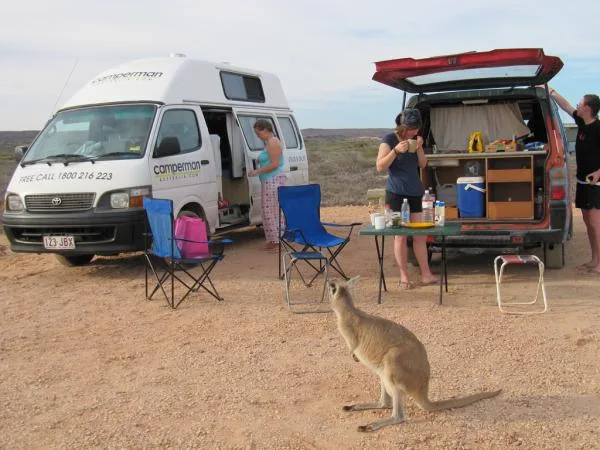
Camperman is a smaller, independent operator based in Queensland with depots in Brisbane and Cairns. They're worth knowing about for long-term hire because their rates for 30-day-plus bookings are genuinely competitive, and the company is small enough that you're often dealing directly with someone who can actually make a decision. If you're doing a Queensland-focused trip or starting from the north, get a quote from Camperman before you commit elsewhere.
Mighty, Cheapa Campa, and Star RV
Mighty and Cheapa Campa are budget-tier brands under the same Apollo group umbrella. For long-term hire on a tight budget, Cheapa Campa in particular can offer very low daily rates — sometimes under $70 AUD for a basic two-berth on a 30-day booking — but the vehicles are older and the kilometre inclusions need careful checking. Star RV sits at the premium end of the Apollo group, comparable to Maui, and is worth considering if you want a large motorhome for a family trip of several months.
Lets Go Motorhomes
Lets Go is an independent operator with a strong reputation for customer service and well-maintained vehicles. They're particularly popular in Queensland and are worth a look for anyone planning a longer trip through the state or heading up to Cape York. Their long-term rates are competitive and they're generally flexible on hire conditions for extended bookings.
Comparison Table: Long-Term Hire at a Glance
| Operator | Price Tier | Monthly Discount | Unlimited KMs Available | Min. Hire Period | Best For |
|---|---|---|---|---|---|
| Apollo | Mid | Yes, tiered | Yes (select at booking) | 5–7 days | Flexibility, large depot network |
| Britz | Mid | Yes, early-bird stacks | Yes (extra cost on some) | 5 days | Cross-country routes |
| Maui | Premium | Limited | Yes | 5 days | Comfort over long distances |
| Jucy | Budget | Yes | Check carefully | 3–5 days | Solo/couple, east coast |
| Travellers Autobarn | Budget–Mid | Yes, monthly packages | Yes | 7 days | Long-term east coast trips |
| Camperman | Budget–Mid | Yes, 30+ days | Yes | 5 days | Queensland-based trips |
| Cheapa Campa | Budget | Yes | Check carefully | 5 days | Lowest daily rate priority |
| Star RV | Premium | Limited | Yes | 7 days | Families, large motorhomes |
| Lets Go | Mid | Yes | Yes | 5 days | Queensland, customer service |
| Mighty | Budget | Yes | Check carefully | 5 days | Budget with more space than Cheapa |
What to Actually Negotiate
Most travellers don't realise that long-term campervan hire is negotiable in ways that short-term hire simply isn't. When you're bringing an operator $3,000–$8,000 or more in revenue, you have leverage. Here's where to use it.
One-Way Fees
One-way fees — charged when you pick up in one city and drop off in another — can add $300 to $800 AUD to your total cost. On a long-term hire, this is often negotiable, particularly on routes where the operator needs vehicles repositioned anyway. Sydney to Perth, Cairns to Melbourne, and Darwin to Adelaide are common relocation routes where operators are frequently motivated to reduce or waive one-way fees. Ask directly. The worst they can say is no.
Insurance Excess Reduction
Standard excess on most campervans sits between $3,000 and $7,500 AUD. Operators sell daily excess reduction packages, typically $25–$45 AUD per day, which adds up significantly on a 60-day hire. For long-term bookings, ask whether a capped excess reduction rate is available — some operators will offer a flat fee for the full hire period rather than a daily charge.
Kilometre Inclusions
Always confirm whether unlimited kilometres are included or whether you're on a daily cap (commonly 100–200 km per day). On a three-month trip around Australia — the classic loop from Sydney through the Red Centre, across to Perth, up the WA coast, and back via Darwin — you'll easily cover 15,000–20,000 km. A kilometre cap at that scale becomes a very expensive problem.
Generator and Equipment Inclusions
For long-term hire, ask what's included in terms of camping equipment, solar panels, and generators. Some operators will add a portable solar panel or a camping table-and-chairs set for free on extended bookings. It doesn't hurt to ask, and it saves you buying or hiring gear separately.
Minimum and Maximum Hire Periods
Most operators set a minimum hire period of five to seven days, though some budget operators will go as low as three days. For long-term discounts to kick in, you're generally looking at 21 days as the threshold where pricing starts to shift meaningfully, with the best rates typically available at 28 days or more.
Maximum hire periods are less commonly discussed but do exist. Most major operators cap continuous hire at around 90 to 180 days, after which the vehicle needs to return for a scheduled service. If you're planning a six-month trip, discuss this upfront — some operators will arrange a mid-hire service at a convenient depot location rather than requiring you to return the vehicle entirely.
Seasonal Timing and How It Affects Long-Term Rates
Picking up in the shoulder season — April to May or September to October — typically gives you more negotiating room than a December or July start date. If you're flexible on when your trip begins, a late-April departure from Brisbane heading north to Cairns and then west to Darwin puts you ahead of the peak winter tourist season in the Top End while still getting reasonable rates. Conversely, starting a long trip in July from Darwin means you're competing with every other traveller who had the same idea.
For coastal NSW trips, the Best NSW Coastal Road Trips by Campervan guide covers timing and routing in detail.
How to Compare Operators Efficiently
Getting quotes from nine different operators for a 60-day hire is genuinely time-consuming. Using CamperCompare to run a side-by-side comparison across operators for your specific dates and route is a practical starting point — it surfaces the base rates quickly so you know who's in the ballpark before you start making phone calls to negotiate the finer details.
One thing to keep in mind: online quote tools don't always reflect the best available long-term rate. Once you've identified two or three operators who are competitive on the base rate, call them directly and mention the hire length. That's when the real conversation starts.
If you're a younger driver navigating age restrictions and surcharges, the Best Campervans for Young Drivers and P-Platers in Australia guide covers which operators are most accommodating.
The Gotchas to Watch For
- Blackout dates: Some long-term hire agreements exclude peak periods like Christmas and Easter from the discounted rate, reverting to standard daily pricing for those days.
- Fuel type: Confirm whether the vehicle runs on diesel or petrol. On a long trip, diesel is significantly cheaper to run and more widely available in remote areas.
- Tyre damage exclusions: Many standard insurance packages exclude tyre and windscreen damage. On a long trip through outback Queensland or the Gibb River Road in WA, this matters. Check whether tyre cover is available as an add-on.
- Restricted roads: Most hire agreements prohibit certain unsealed roads. If your route includes the Gibb River Road, the Oodnadatta Track, or Cape York, confirm this explicitly before you book — not after you've already driven 2,000 km to get there.
- Generator fuel costs: If the vehicle has a generator, clarify who pays for the fuel it uses. On a long hire, this is a non-trivial cost.
A Quick Note on Buying vs Hiring for Very Long Trips
If you're planning a trip of six months or more, it's worth at least running the numbers on buying a second-hand campervan versus hiring one. For trips under four months, hire almost always makes more financial sense when you factor in registration, insurance, maintenance, and the hassle of selling at the end. Beyond that, the calculation gets closer. This guide focuses on hire, but it's a question worth asking yourself before you commit either way.
Curious how Australia's long-term hire market compares to other destinations? The Best Campervan and RV Rental Companies in Canada guide offers a useful point of comparison if you're planning a multi-country trip.
Planning your trip?
Compare campervan & motorhome hire prices across Australia: