
Why comparing motorhome hire properly actually matters
Booking a motorhome in Australia without comparing your options is a bit like buying a car by walking into the first dealership you see. The price difference between operators for the same route and dates can easily be $500–$1,500 over a two-week trip. Add in fuel policies, kilometre caps, insurance excess levels, and one-way fees, and two quotes that look similar on the surface can end up worlds apart in real cost.
This guide walks you through exactly how to compare motorhome hire in Australia — what to look at, what to ignore, which operators suit which travellers, and how to avoid the gotchas that catch people out every season.
The main operators and where they sit in the market
Australia has a well-developed motorhome hire industry, with operators ranging from budget-focused fleets to premium self-contained rigs. Here is a quick breakdown of who is who.
Premium tier: Maui and Star RV sit at the top end. Expect newer vehicles, higher-spec fit-outs, and daily rates typically in the $250–$450 range depending on season and vehicle size. Apollo's higher-end models overlap here too. If you are weighing up those two, the Maui vs Apollo motorhome comparison breaks down the differences in detail.
Mid-range: Britz, Apollo, and Mighty occupy the middle ground — solid fleets, reasonable inclusions, and daily rates roughly in the $150–$280 range. These are the workhorses of the Australian motorhome hire market and suit most travellers well.
Budget tier: Cheapa Campa, Camperman, and Jucy offer the most competitive rates, often $90–$180 per day, though vehicles tend to be older and inclusions more basic. Travellers Autobarn also competes here, particularly for younger travellers and backpackers. For a head-to-head on that end of the market, see the Travellers Autobarn vs Jucy comparison.
Independent operators: Lets Go Motorhomes and Cruisin' Motorhomes offer an alternative to the big corporate fleets, often with more personalised service and competitive pricing on specific routes.
Comparison table: Major operators at a glance
| Operator | Market position | Typical daily rate (indicative) | One-way hire | Best for |
|---|---|---|---|---|
| Maui | Premium | $280–$450 | Yes | Couples, comfort seekers |
| Star RV | Premium | $260–$420 | Yes | Families, longer trips |
| Apollo | Mid–Premium | $160–$320 | Yes | Wide range of travellers |
| Britz | Mid-range | $150–$280 | Yes | Families, road trippers |
| Mighty | Mid-range | $130–$240 | Yes | Value-focused travellers |
| Cheapa Campa | Budget | $90–$170 | Yes | Budget travellers |
| Camperman | Budget | $95–$175 | Limited | Budget, shorter trips |
| Jucy | Budget | $90–$160 | Yes | Younger travellers, pairs |
| Travellers Autobarn | Budget | $85–$155 | Limited | Backpackers, budget trips |
| Lets Go | Mid-range | $140–$260 | Yes | Families, grey nomads |
All rates are indicative and vary significantly by season, vehicle class, and booking lead time. Always check current pricing directly or via a comparison tool like CamperCompare.
The five things that actually determine total cost
The daily rate is just the starting point. When you compare motorhome hire quotes, these five factors often matter more.
1. Kilometre allowances
Most operators offer either unlimited kilometres or a daily cap — commonly 100 km to 200 km per day — with excess charges of $0.25–$0.45 per kilometre beyond that. On a route like Sydney to Cairns (roughly 1,900 km direct, more if you explore), a tight cap can add hundreds of dollars. Always calculate your expected daily average before booking.
2. Insurance excess and reduction options
Standard excess on Australian motorhome hire typically sits between $3,000 and $7,500. Operators sell excess reduction packages — often called Basic, Standard, or Premium cover — ranging from around $25 to $65 per day. Third-party excess reduction products (like those from Tripcover or similar) can sometimes be cheaper, but check the fine print carefully for exclusions around single-vehicle accidents, tyre damage, and water crossings.
3. One-way fees
Hiring from Sydney and dropping in Darwin? Expect a one-way fee, which can range from $150 to $600 or more depending on the route and operator. Some routes — particularly those that help operators reposition vehicles — attract little or no fee, or even relocation deals. Checking both directions before you commit can save you real money.
4. Seasonal pricing
School holidays and peak season (December–January in the south, June–August in the north) push rates up sharply. Booking the Kimberley in July? Rates from Broome depots can be 40–60% higher than the shoulder season equivalent. For a full breakdown of what to expect hiring from the north-west, the Broome motorhome hire guide covers depot options and Kimberley-specific prep in detail.
5. Minimum hire periods
Many operators enforce minimum hire periods — often five to seven days in peak season, sometimes ten days for one-way hires. If you only need four days, you may still pay for seven. Factor this into your cost-per-day calculation.
Choosing the right vehicle class
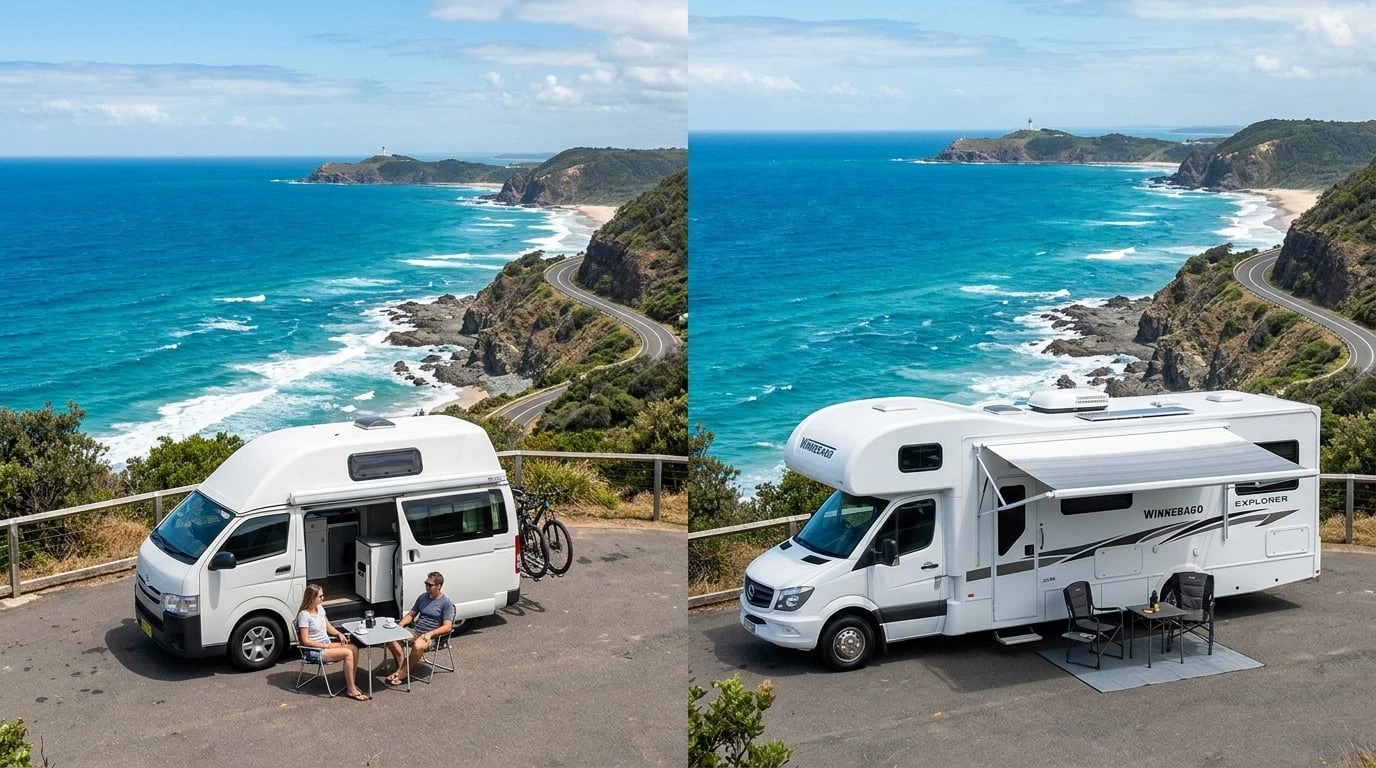
Not sure whether you even need a full motorhome versus a campervan? That is worth settling before you start comparing operators. The campervan vs motorhome comparison covers the practical trade-offs — size, cost, campsite access, and driving comfort — in detail.
If you have decided a motorhome is right for you, the main classes to compare are:
- 2-berth motorhomes: Compact, easier to drive and park, good fuel economy. Suits couples doing coastal routes or city-to-city trips.
- 4-berth motorhomes: The most popular class. Fixed double bed plus dinette conversion or bunk configuration. Works for couples wanting more space or small families.
- 6-berth motorhomes: Full family rigs with separate sleeping areas. Wider, heavier, and harder to park in tight spots. Daily rates climb significantly.
- Luxury/high-spec motorhomes: Slide-outs, full ensuite, solar, premium appliances. Maui's Ultima and Star RV's top-tier models fall here. Expect $350–$500+ per day in peak season.
Popular routes and what they cost to compare
Route choice affects which operators are even available to you, since not all brands have depots in every city.
East Coast (Sydney–Cairns or Brisbane–Cairns): The most competitive route in Australia. Nearly every major operator has depots at both ends, which keeps pricing honest. A two-week mid-range motorhome hire on this route typically runs $2,500–$4,500 all-in, depending on season and vehicle class. Brisbane is a popular starting point — the Brisbane motorhome hire guide covers depot locations, pickup logistics, and route planning from there.
Melbourne–Adelaide or Melbourne–Sydney: Shorter routes, good for first-timers. Melbourne has strong depot coverage from most operators. See the Melbourne campervan and motorhome hire guide for a full rundown of what is available from the city.
Darwin–Broome or the full lap: These longer routes suit grey nomads and serious road trippers. One-way fees apply on most, and minimum hire periods are often longer. If you are considering a full circumnavigation, the lap of Australia motorhome guide is worth reading before you start comparing quotes.
How to actually compare motorhome hire quotes side by side
Here is a practical process that saves time and avoids nasty surprises at pickup.
- Fix your route and dates first. Vague searches return vague results. Know your pickup city, drop-off city, and exact dates before you start.
- Use a comparison platform. CamperCompare lets you search across multiple operators simultaneously, so you can see real availability and indicative pricing side by side rather than tabbing between a dozen websites.
- Add the same inclusions to each quote. Select the same insurance level, kilometre package, and extras (camp chairs, linen, GPS) across all quotes so you are comparing like with like.
- Check the excess amount, not just the daily rate. A quote that looks $20/day cheaper but carries a $7,000 excess versus a $3,000 excess is not necessarily better value.
- Read the one-way and drop-off fee line. It is often buried in the booking summary rather than the headline price.
- Confirm the depot address and pickup time. Some operators have depots 20–30 km from the city centre or airport. Factor in transfer costs and time.
Common gotchas when you compare motorhome hire
- Fuel policy differences: Most Australian operators use a full-to-full policy, but confirm this at pickup. Returning with a near-empty tank and being charged a refuelling fee at inflated rates is avoidable.
- Generator hour limits: Some motorhomes include a generator with a daily hour cap (often two to four hours). Exceeding it incurs charges. If you are free camping regularly, check this.
- Tyre and windscreen exclusions: Many standard insurance packages exclude tyre damage and windscreen chips. On outback routes, this matters. Upgrade your cover or check your credit card travel insurance carefully.
- Age surcharges: Drivers under 25 often pay a young driver surcharge of $5–$15 per day. Some operators set the minimum age at 21, others at 18 with restrictions.
- Unsealed road restrictions: Most hire agreements prohibit driving on unsealed roads, or void your insurance if you do. If your route includes gravel tracks — the Gibb River Road, for example — you need to specifically confirm the vehicle and policy allow it.
Final word
The Australian motorhome hire market is competitive, which is good news for you — but only if you actually compare properly. A five-minute search that grabs the first result is not a comparison. Work through the total cost, check the fine print on insurance and kilometres, and match the vehicle class to your actual route and group size. Do that, and you will almost certainly end up with a better trip for less money.
Planning your trip?
Compare campervan & motorhome hire prices across Australia: