Working Remotely From a Campervan in Australia: What You Actually Need to Know
Working remotely from a campervan in Australia is genuinely doable — thousands of people are doing it right now, from Byron Bay car parks to Margaret River caravan parks to the shaded rest stops outside Alice Springs. But it requires more planning than a standard holiday hire. Connectivity drops out, batteries die at the worst moment, and some of the most beautiful spots in the country have zero mobile signal. This guide cuts through the fantasy and gives you a realistic picture of what works, what doesn't, and how to set yourself up properly.
The Connectivity Reality Check
Australia's mobile coverage looks impressive on carrier maps and is genuinely good along the east coast, in major regional centres, and on well-travelled highways. The moment you head inland or into national parks, it thins out fast. For working remotely from a campervan in Australia, your mobile data setup is the single most important decision you'll make.
Which Carrier to Choose
Telstra has the largest 4G footprint by a significant margin — roughly 2.5 million square kilometres of coverage compared to Optus and Vodafone, which are strong in cities and coastal corridors but patchy beyond them. If you're staying on the east coast between Cairns and Melbourne, Optus is a reasonable and cheaper option. If you're doing any inland travel — the Nullarbor, the Kimberley, outback Queensland — Telstra is non-negotiable.
A prepaid SIM with a large data plan is the starting point. Telstra's prepaid plans run from around $55–$85/month for 40–180GB depending on the current offer. Optus and Vodafone are typically $10–$20 cheaper for equivalent data. Many nomads run two SIMs — a Telstra SIM in a dedicated mobile router and an Optus SIM in their phone — to cover gaps in each network.
Mobile Routers and Signal Boosters
A dedicated 4G/5G mobile router (Netgear Nighthawk M6, TP-Link M7350, or similar) gives you a proper Wi-Fi network in the van and handles multiple devices without draining your phone battery. Expect to pay $150–$400 for a decent unit. Pair it with an external antenna or a signal booster like the WeBoost Drive Reach (around $700–$900 AUD) if you're regularly working from fringe-coverage areas. The booster won't create signal from nothing, but it can pull a weak bar into something usable.
Starlink's portable satellite internet is increasingly popular with long-term van lifers. The hardware costs around $599 and the service runs $150/month. It's heavy, draws significant power, and needs a clear sky view, but in genuinely remote areas it's transformative. Worth it if you're spending months off the beaten track.
Power: Keeping Your Devices Running All Day
A standard hire campervan's 12V system is designed for lighting, a fridge, and charging phones overnight — not for running a laptop, monitor, and router for eight hours a day. Before you book, you need to understand what's under the bonnet electrically.
What the Van Needs
A typical laptop draws 45–90W. Add a router (10–20W), phone charging, and maybe a small monitor (20–40W), and you're looking at 75–150W of continuous draw during work hours. Over an eight-hour day, that's 600–1,200Wh of energy. Most standard hire vans have a 100–120Ah auxiliary battery, which gives you roughly 600Wh of usable capacity (you shouldn't discharge below 50% on a lead-acid battery). That's tight.
The solution is solar. A 200W rooftop solar panel in Australian sun will generate 800–1,200Wh on a good day — enough to cover your work load and keep the fridge running. Many operators now offer vans with 200W+ solar as standard or as an upgrade. When comparing vehicles on CamperCompare, filter for solar capacity and battery size if you're planning to work from the van seriously.
Operators and Van Specs Worth Knowing
For long-term work-friendly setups, the larger operators vary considerably. Travellers Autobarn's Hitop and Kuga models have 200W solar and a 120Ah lithium battery — lithium is a big deal because you can discharge to 20% without damage, effectively doubling usable capacity. Apollo's Euro Camper and Endeavour models have 200W solar. Maui's Beach Camper is more basic. Jucy's Crib and Chaser are compact and better suited to weekend trips than months of laptop work. Mighty, Cheapa Campa, and Camperman sit at the budget end and typically have smaller battery setups — fine for occasional work, not ideal for full-time remote work.
Star RV and Maui's larger motorhomes (Ultima, River) have 240V inverter systems and larger battery banks — genuinely comfortable for full-time work, but daily hire rates are higher ($180–$350/day depending on season). For a detailed breakdown of long-term hire costs and which operators offer the best rates for extended bookings, see our guide to the best campervan companies for long-term hire in Australia.
If you're weighing up whether hiring long-term even makes financial sense versus buying a van outright, the renting vs buying a campervan in Australia guide runs the numbers honestly.
The Best Long-Stay Bases for Remote Workers
The smartest approach for working nomads is to move slowly — spend two to four weeks in one spot rather than driving every day. Driving burns fuel, time, and energy you need for work. Here are the bases that consistently work well.
Byron Bay and the Northern Rivers, NSW
Strong Telstra and Optus 4G, a large community of remote workers, excellent cafés with Wi-Fi as backup, and a caravan park scene that caters to long-stayers. Reflections Holiday Parks Byron Bay charges around $45–$65/night for a powered site. The climate from April to October is ideal — warm but not oppressive. Avoid school holidays unless you book months ahead.
Margaret River, WA
Reliable 4G coverage, a relaxed pace, and powered sites at parks like Prevelly Park Beach Resort ($40–$60/night). The region is 270km south of Perth. Winters (June–August) are mild and quiet — good working conditions. Summers get busy with tourists.
Airlie Beach and the Whitsundays, QLD
Good coverage, a year-round warm climate (though November–April is cyclone season and very humid), and several caravan parks with long-stay rates. Airlie Beach Tourist Park has powered sites from around $45/night with weekly discounts available.
Hobart, TAS
Underrated for nomads. Strong coverage, a thriving café culture, and caravan parks like Treasure Island Holiday Park in Sorell (20 minutes from the CBD) with powered sites around $40–$55/night. Summers (December–February) are genuinely pleasant. Winters are cold but manageable with a diesel heater.
Cairns, QLD
A major hub with excellent 4G, co-working spaces, and caravan parks within 10–15km of the city. Cairns Coconut Holiday Resort has powered sites from $50/night. The dry season (May–October) is the sweet spot — low humidity, clear skies for solar generation.
Van Setup Comparison: What Suits Laptop Work
| Van Type | Solar (typical) | Battery | Work Surface | Best For | Approx. Daily Rate (long-term) |
|---|---|---|---|---|---|
| Budget campervan (Cheapa, Mighty small) | 80–100W | 100Ah lead-acid | Fold-out table only | Occasional work, mostly powered sites | $80–$120/day |
| Mid-range hitop (Travellers Autobarn Hitop, Apollo Euro) | 200W | 120Ah lithium or AGM | Fixed or fold-out table | Full-time work with good solar days | $110–$160/day |
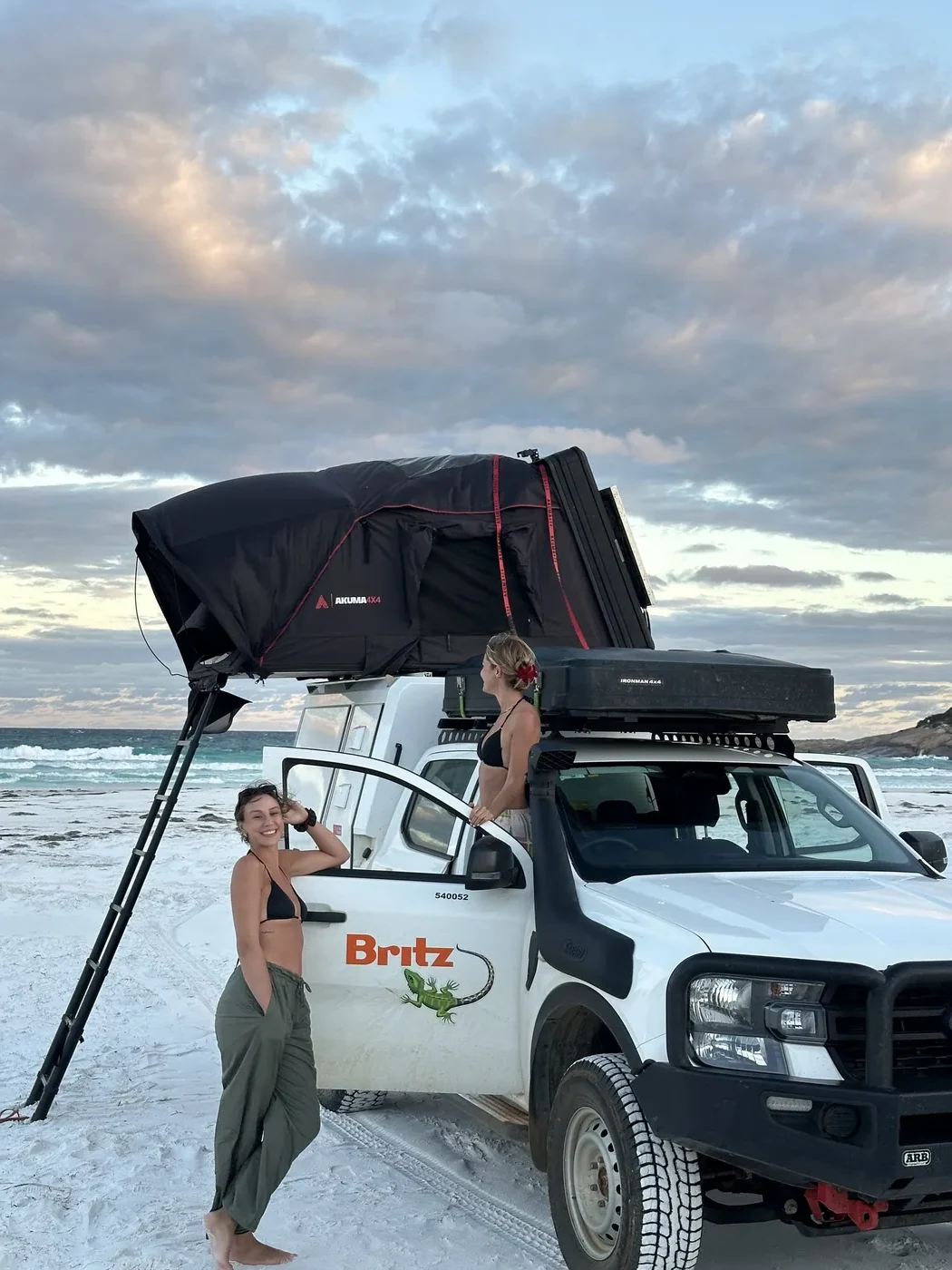
| 4WD camper (Britz 4WD, Apollo Overlander) | 200W | 120–150Ah lithium | Fold-out table, limited | Remote travel + work, needs Starlink | $150–$220/day |
| Large motorhome (Star RV, Maui Ultima) | 200–300W | 200Ah+ lithium, 240V inverter | Dedicated dinette desk | Comfortable full-time work setup | $180–$350/day |
Note: daily rates are indicative ranges for long-term hire (30+ days) in shoulder season. Peak season and one-way fees will push costs higher. Use CamperCompare to compare current availability and pricing across operators side by side.
Practical Gotchas Nobody Warns You About
- Powered site dependency: If you're relying on 240V shore power at caravan parks every night, you're paying $40–$70/night indefinitely. Budget this properly — it adds up to $1,200–$2,100/month just for accommodation.
- Video calls in the van: Background noise from wind, traffic, and campsite neighbours is real. A good headset with noise cancellation (Sony WH-1000XM5, Jabra Evolve2) is not optional.
- Heat and laptops: Australian summers are brutal. A laptop in a van parked in direct sun can overheat and throttle performance. Park in shade, use a laptop stand for airflow, and consider a small 12V fan.
- Insurance and equipment: Standard hire van insurance does not cover your laptop, camera, or work equipment. Check your travel insurance policy carefully. For a full breakdown of what van hire insurance does and doesn't cover, read our campervan insurance guide.
- Time zones: If you're working with clients or a team in a fixed time zone, moving between states means managing daylight saving changes (NSW, VIC, SA, TAS observe it; QLD, WA, NT do not).
- Hire van restrictions: Most operators prohibit taking their vans on unsealed roads. If your ideal remote work spot requires a dirt track, check the terms carefully or book a 4WD-rated vehicle.
Visas and Long-Term Hire Considerations
If you're on a Working Holiday Visa (subclass 417 or 462), you can absolutely work remotely from a campervan — the visa allows you to work for any employer, including overseas remote employers, as long as you comply with the 6-month rule for working with the same employer. For a full breakdown of how campervan hire works on a WHV, including age restrictions and licence requirements, see our Campervan Hire Working Holiday Visa guide.
For UK travellers specifically, there are some additional considerations around licence validity and operator preferences — the complete guide for UK travellers covers these in detail.
Making It Work: A Realistic Weekly Rhythm
The nomads who sustain this lifestyle long-term tend to follow a similar pattern: stay in one base for two to three weeks, work standard hours Monday to Friday, use weekends to explore nearby areas without driving far, then move to the next base. They're not driving every day. They're not chasing Instagram spots at the expense of deadlines. They've accepted that some days the internet is slow and they work from a café instead.
The van becomes an office, a bedroom, and a kitchen — and that's genuinely freeing once you stop expecting it to be a hotel. The setup cost (good SIM plan, router, possibly a signal booster) is real but one-off. The ongoing costs — fuel, powered sites or free camping, food — are often lower than renting a flat in a city.
If you're trying to work out the full cost picture before committing, our campervan hire cost guide breaks down what you'll actually spend across different van types and trip lengths.
Planning your trip?
Compare campervan & motorhome hire prices across Australia: